
Background
American President George W. Bush called for a new compact on March 14, 2002 for development with accountability for both rich and poor countries. The US Congress approved legislation for the establishment of MCC in 2004. The MCC was formed with the objectives of – to reduce poverty through economic growth.
How it started in Nepal
The then joint secretary of Nepal Baikuntha Aryal and Jonathan Nash, acting chief of the MCC signed an agreement in September 2017 (witnessed were Gyanendra Bahadur Karki( finance minister) and John J Sullivan (US Deputy Secretary of State). The US government agreed to provide $ 500 million in grants while Nepal have to put $130 million for the project of energy and roadways which was again signed during the meeting of Nepali Foreign Minister Pradeep Gyawali with US Secretary of State Mike Pompeo.
Why it became controversial
The Indo-Pacific Strategy Report clearly says that support under the compact is a part of IPS. The MCC compact doesn’t say it needs to be ratified by Nepali parliament. The text of agreement says that provision in the compact will prevail over Nepal’s existing laws in the case of conflicts, which requires parliamentary ratification, according to the Nepal Treaty Act. The MCC is the first grant agreement that requires parliamentary approval.
America’s Indo-Pacific Strategy, together with MCC are seen as a concern for Nepali national security. Indo-Pacific Command designated India as a major defense partner. Malabar exercise and revival of Quad is the example of Indo-US partnership. MCC, a part of IPS not only affects Nepali neutrality but also encourages military engagement in the region.
The debate
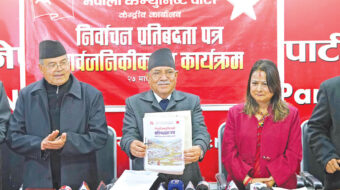
Intellectuals, academicians and political leaders are fully concentrated in a debate regarding the adoption of the $500 million American grant project under the Millennium Challenge Corporation (MCC). CPN and its leadership clearly divided in two groups about the ratifying the MCC Compact.
Among the political parties, the Nepali Congress is of the view of adoption the project as early as possible. However, the ruling Nepal Communist Party is divided on accepting the American grant. Bhim Rawal, Mani Thapa, Lilamani Pokhrel, Dev Gurung and others from the CPN are the strong critics of the MCC. They have remarked that MCC is an organ of the Indo-Pacific Strategy (IPS) an American military alliance against China. Therefore, Nepal, a non-aligned nation, should not join any military pact.
Nevertheless, the American diplomats and senior officials during their Kathmandu visit had confirmed that MCC is an organ under the IPS; however, they have claimed that IPS is not a military alliance aimed at any country.
Prime Minister KP Oli is of the view of endorsing MCC from the ongoing session of the Parliament (last date is June 30 if not extended). Therefore, in spite of serious debate in the ruling party, though majority leaders are against MCC, sooner or later, MCC seems to be endorsed because of Oli, his team and Nepali Congress- the opposition. It is said that US Embassy has asked the government to endorse MCC as earliest as possible; otherwise, it is going to scrap the grant project.
Intellectuals are of the view that intention of the donor country should be clear. Nepal should adopt such grant projects under the guidelines of the constitution and other existing laws. The MCC project, after endorsement from the Federal Parliament, will itself be a part of the law and will remain above the existing laws of the country. So, in this condition, Nepal should not accept this grant project.
According to the grant proposal, audit of the projects under MCC should be conducted by the American companies only. Firstly, Nepal should invest on the project under MCC and MCC-Nepal will reimburse the fund later. During the time of reimbursement, the Americans may put some conditions like security concern. In the name of security they may came to Nepal and permanently settled here.
In this very time when a debate was going on, government seems- forgotten its standard foreign policy and is trying to hurt its immediate neighbour by developing strategic alliance with other countries.
Majority of CPN leaders (who have nationalist image), believe that MCC is against Nepal’s sovereignty and are publicly saying that the American army will enter through the project. Not only the leaders but the ordinary Nepali Citizen also believes so. Nepal is going to handover its ownership to the Americans through this project. Majority of Nepali citizens say that Nepal should not exchange its sovereignty just for US$ 500 million. They have suggested to collect the debt revenue from Ncell which is much more than MCC grant for its development.
Result after Ratification
The MCC project, after endorsement from the Federal Parliament, will itself be a part of the law and will remain above the existing laws of the country which is the major concern for independent and sovereign nation like Nepal.
When debate is going on about MCC, the mainstream media were flooded with special reports, editorials, and expert opinions in support of MCC are very curious in this regards. It is in the Nepali parliament and its authorization goes to the parliamentarians to accept, reject, revise or ratify. But the so-called intellectuals are making hue and cry to pressurize the government infavour of MCC which makes it again suspicious.
Conclusion
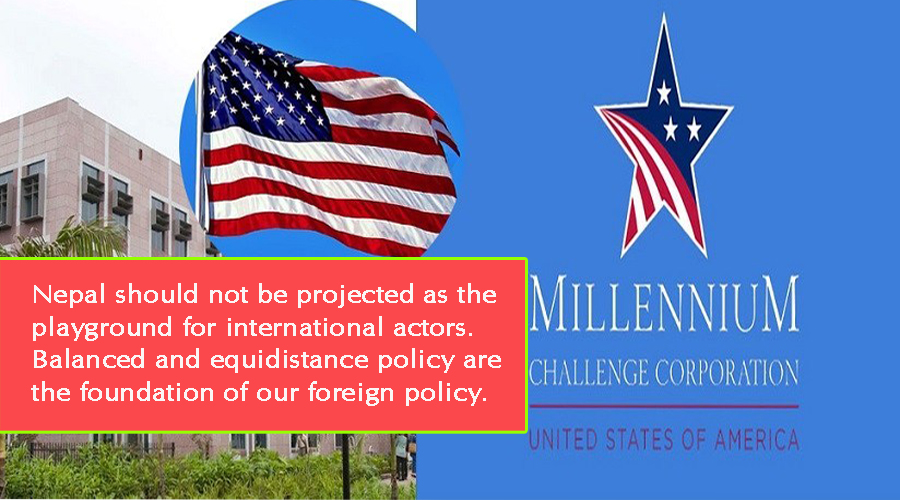
MCC is the project aimed to continuing American dominance. Firstly, MCC was introduced in South Africa when Chinese investment was intensified there. After then it designed for other smaller but strategic countries to influence them. So, Nepal should aware of ground reality, not align with any of the countries. Nepal should not be projected as the playground for international actors. Balanced and equidistance policy are the foundation of our foreign policy. Nepal has no other options except following our standard foreign policy. This is our geographical compulsion.
Nepali leaders, intellectuals, media and all the stake holders should wakeup our leaders. So called Communist leaders of the ruling party are less bothered about diplomatic norms and values. They even don’t know how to deal with the diplomatic issues affecting bilateral relations.To fulfill the vested interest of some countable leaders Nepal may not be allowed to turn it into another Afghanistan.